
From Navigation to Discovery: How Maps are Becoming More Social
New research from Snap Inc., eye square, and Horizon reveals how digital maps are transforming from utility-driven navigation grids into social canvases – unlocking a new demand-generation playbook for brands to drive real-world foot traffic.
The Digital Map has Changed: From Point A to Social Connection
For decades, the digital map was defined by an utilitarian question: "How do I get from Point A to Point B?" Today, maps are evolving from rigid directional grids into vibrant ecosystems for social connection, cultural exploration, and serendipitous discovery. Snapchat partnered with eye square and Horizon to better understand how digital maps are redefining how consumers move about the physical world.
Together, we surveyed over 17,000 digital map users aged 13-44 across the US, Canada, UK, France, Germany and Saudi Arabia, and leveraged in-context testing to understand how sponsored pins on social maps drive real brand outcomes. Ultimately, the findings create an entirely new demand-generation playbook for modern marketers looking to bridge the gap between digital discovery and real-world foot traffic.
The map is becoming less of a mirror of where people are going and more of a catalyst for where they go next. That’s a meaningful shift for marketers. When consumers are exploring without a fixed destination, brands have a chance to influence the journey before a traditional purchase decision even begins.
Laura Sammartino, SVP Future of Consumer and Culture, Horizon Media
The Evolution of Maps: From Intent to Serendipitous Discovery
For most consumers, maps are part of the daily routine – 71% of consumers state maps are important to their daily lives. 1 However, maps are no longer just about intent (“I know where I’m going”), but now anchored in serendipitous discovery (“I’m discovering where I want to be”) – 70% of users enjoy browsing maps with no specific destination in mind. 1
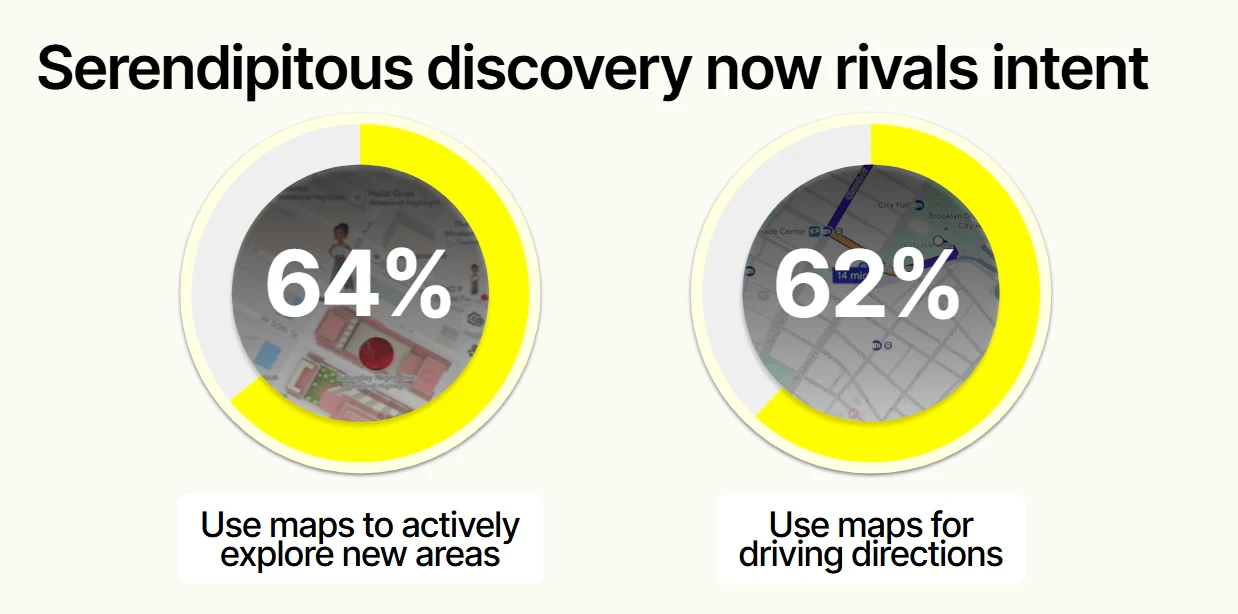
The mindset shift between intent and serendipitous discovery explains why consumers do not pick just one platform. Instead, they use various platforms based on the need to execute a route or discover an experience.

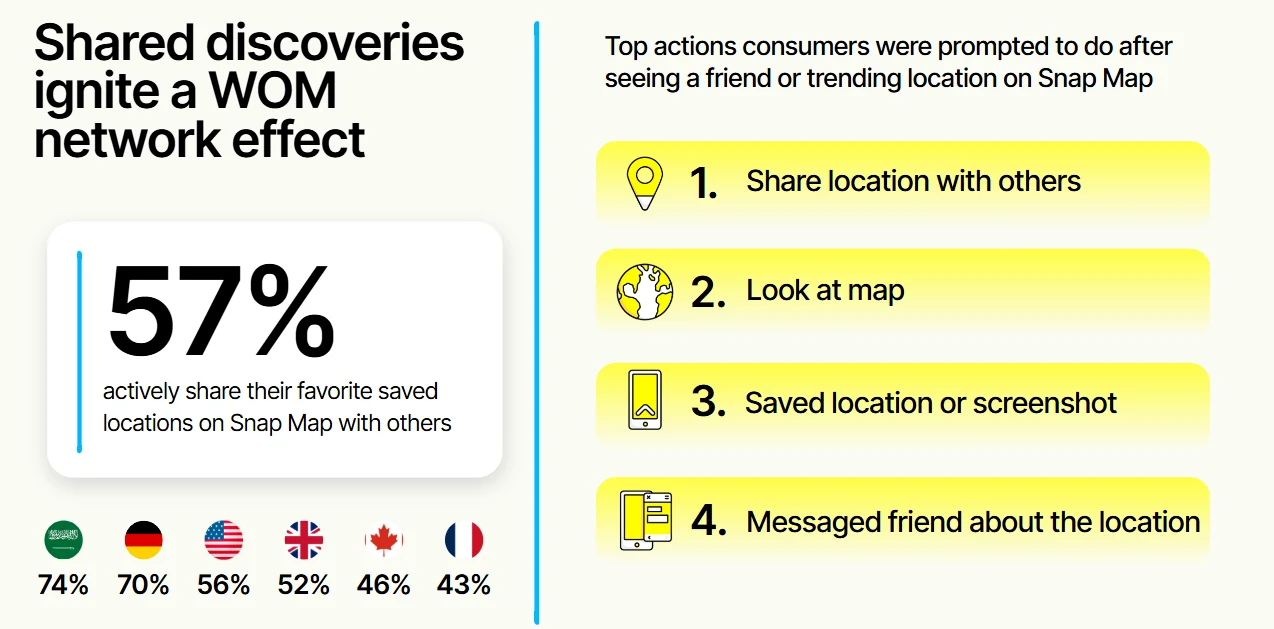
Maps have also become digital filing cabinets for cataloging real-world footprints. When uncovering new spots during destinationless journeys, consumers save lifestyle-centric spaces from restaurants & cafes (45%), friends & family addresses (43%) to parks & outdoor spaces (33%), shops & retail (33%), and travel destinations (30%). 1 Bookmarking triggers a powerful word-of-mouth (WOM) network effect. 68% of users send interesting map locations directly to others, and 57% regularly share their favorite saved locations. 1
Brand Takeaway 📍
Market for the mindset, not just the map: To reach an audience that is universally browsing, gathering social proof, and deciding where to go, brands must look beyond utility maps and show up on social maps where consumers actively hang out and discover culture.
Snap Map: The Epicenter of Serendipity and Human Connection
If traditional navigation apps like Apple and Google are built to help users leave the screen and drive, Snapchat owns the space where they decide where to go in the first place. Consumers are 2.9x more likely to say they discovered their favorite real-world businesses on Snapchat vs. other social platforms. 1
Snapchat transforms the traditional map into an interactive canvas for social connection, where 76% consult Snap maps to see exactly where their friends are and 27% use it to directly coordinate face-to-face meetups. 1 Snap Map, which reaches 450M global monthly active users, 2 extends connection into the real world by helping people discover where life is happening, highlighting what’s happening nearby, and guiding people to explore culturally relevant places.
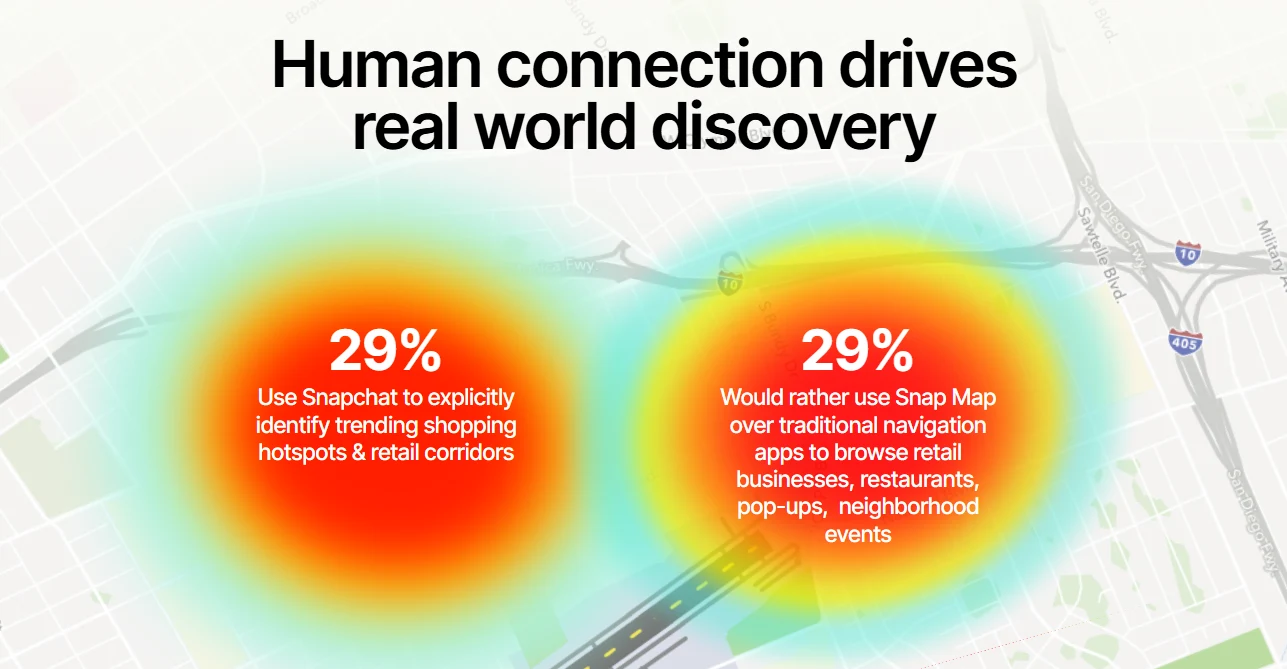
Ultimately, Snap Map creates a ripple effect where social discovery drives visits, and those visits drive even more social discovery.
Brand Takeaway 📍
Shift from search utility to social discovery: By leveraging social maps like Snap, brands can capitalize on foot traffic fueled by human connection and serendipitous discovery that can trigger messaging, peer coordination, and physical footprints.
Brand Opportunity: Social Maps Open Doors for Commerce
Consumers now treat the map as an active discovery engine for shopping, dining, and seeking local experiences, presenting a huge opportunity for brands. Because users are in an active "find and explore" mindset, they welcome branded elements across categories from restaurants, entertainment to retail and hotels for decision-making -- 71% of users reported being open to visiting a physical location after seeing it featured as a sponsored pin. 1
Consumers want to see brand messaging that makes their lives easier, including ‘get me there prompts’ (76%), local event promotions (73%), practical info alerts (73%), new store opening nearby (73%), and personalized location recommendations (72%). 1
Promoted Places Performance: Driving Full Funnel Outcomes
Using an in-context testing environment (11,000+ Global) and post exposure survey among 2,100 users across markets, we evaluated how Promoted Places on Snap Map drives performance compared to promoted pins on utility maps.
Overall, Promoted Places creatives proved to be easier to notice (+9ppt), more appealing (+5ppt), and more interesting to click on (+4ppt) than sponsored pins on utility maps. 1 As a result, Promoted Places also outperformed for driving lifts throughout the entire purchase funnel.
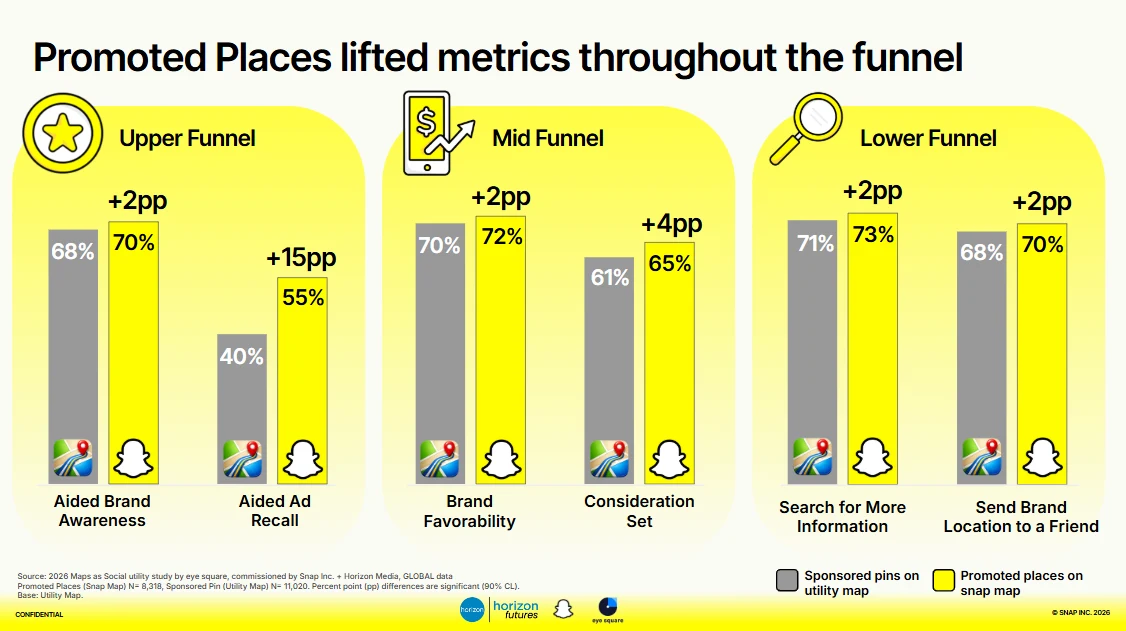
More impressively, brand impact generated by Promoted Places was still salient 14-25 days after seeing the ad with consumers reporting being 1.1X more likely to visit the store after discovering on Snap Maps and 1.1X more likely to have their opinions changed on the brand (vs. those exposed to promoted pins on utility maps). 1
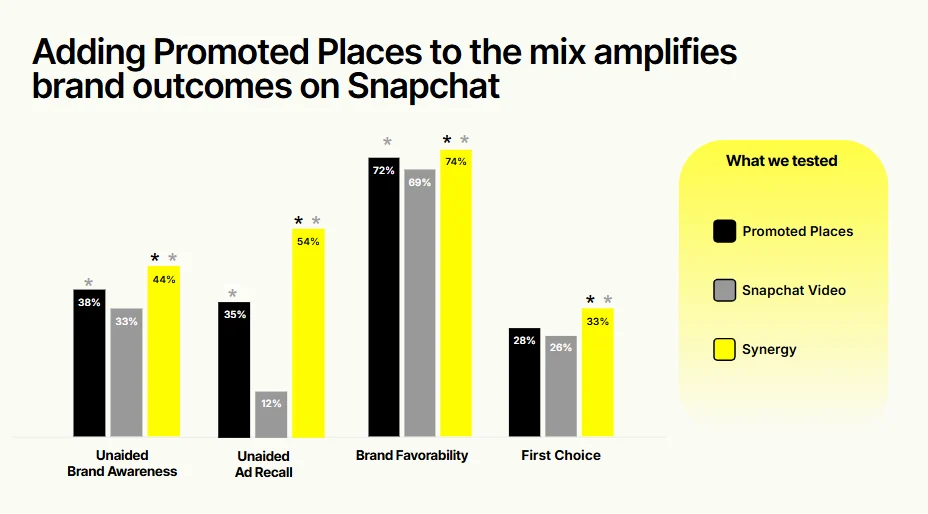
Finally, Promoted Places drove incremental impact to the mix on Snapchat – when combined with Snapchat video on Spotlight, Promoted Places on Snap Map amplified key metrics from awareness, brand affinity to preference.
Brand Takeaway 📍
Social maps amplify performance: By reaching people while they explore, Promoted Places on social maps like Snap maps drive impact across the entire purchase funnel, even more so than promoted pins on traditional utility maps.
The Strategic Brand Playbook for Social Map Activation
Brands can leverage these four actionable pillars to help brands shift from passive pins on Snap Map to purchase-driving experiences.
Optimize for visual serendipity: Map marketing is shifting from intent-based SEO to passive discovery. The goal isn’t just to be found, it’s to be stumbled upon.
Engineer social proof: A cluster of friends is more powerful than any ad. A brand’s location is a social hub. Brands should incentivize check-ins, list saves, and pin shares to create a ripple effect.
Use native utility as the creative concept: Ads on social maps succeed when they function as a service. Replace traditional ad copy with hyper-localized utility. Thoughtful map content makes a brand feel more helpful and innovative.
Bridge the discovery to doorstep funnel: The map offers the shortest marketing funnel in existence, reaching consumers who are mobile and ready to spend. Trigger dynamic, time-sensitive offers (i.e. coupons, flash sales) to convert passive browsing into immediate, real-world foot traffic.
Download the full global report here
Ready to turn location-based discovery into real-world performance? Reach out to your Snap sales representative or launch your next campaign in Snapchat Ads Manager today.
More Ways To Win With Snapchat


Snapchat can help your business grow.