
How to Laugh (and Win) with the Next Generation
New research from Snapchat and Omnicom Advertising explores how Gen Alpha and Gen Z use humor to connect, communicate, and make sense of the world – and what this means for brands.
What’s 67? What’s aura farming? What’s unc? To the older generations, young people’s humor can feel difficult to decode. Yet beneath the memes, inside jokes, and absurd internet trends is something much bigger: a generation using humor as one of its primary social languages.
For Next Gen (ages 13-28), humor is more than entertainment. It is how they build relationships, signal belonging, process serious topics, and navigate culture. Rather than existing purely online, humor moves fluidly between feeds, private chats, creator content, Stories, and real-life conversations, constantly evolving as communities reinterpret and build on it.
To understand this phenomenon, we partnered with Omnicom Advertising to study over 6,000 social media users (ages 13–28) across the US, UK, Canada, France, Germany, and India. The research explores how Gen Z and Millennials define modern humor—including how it spreads, when it becomes "cringe," how brands can participate, and Snapchat's unique role in the ecosystem.
Our research revealed that humor has evolved far beyond entertainment. For the Next Generation, it's become one of their most important social languages—a way to express identity, process emotions, and make sense of the world around them. That shift is exactly why it's so important for brands to understand how humor works today.
Humor Has Become Emotional Infrastructure
Every generation has had its own references, inside jokes, and cultural shorthand. In fact, 73% of Next Gen believe their generation has the best sense of humor 1. But today's humor moves faster, spreads further, and evolves more collaboratively than ever before.
Rather than separating serious moments from funny ones, Next Gen often use humor to process them together:
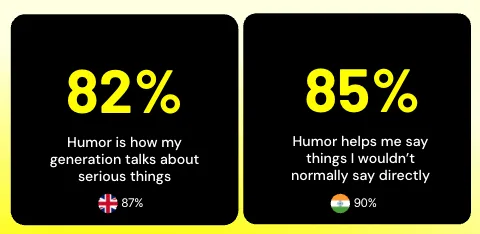
In addition, 67% also say they choose friends based on their sense of humor, and 57% say who understands a joke matters more than how many people like it, showing that humor increasingly functions as a signal of identity and belonging rather than simply entertainment 1.
This matters for brands because humor increasingly drives commercial outcomes as well as cultural ones:
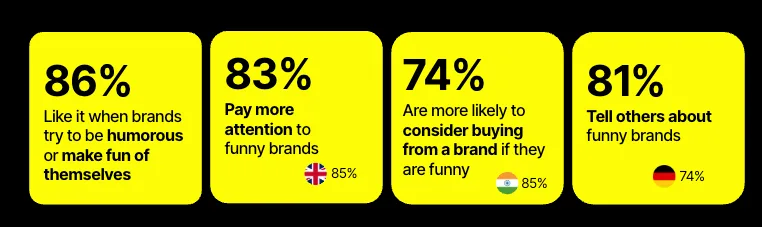
Yet the opportunity comes with a warning: Three in four young people also say brands often feel like "older people trying to joke with them." 1 Understanding Next Gen humor has become a business challenge as much as a creative one.
Modern Humor Follows New Rules
Although Next Gen humor often appears chaotic, it follows a surprisingly consistent set of rules.
First, context is the punchline. The same joke can mean completely different things depending on where it appears, who shares it, and whether the audience understands the reference. Nearly Nine in 10 say you need to "get the reference" for some jokes to make sense, while 79% agree that explaining a joke ruins it 1.
Second, random has rules. While "completely random" is the type of humor Next Gen like most, 92% agree that the best jokes seem random but actually have logic behind them 1.
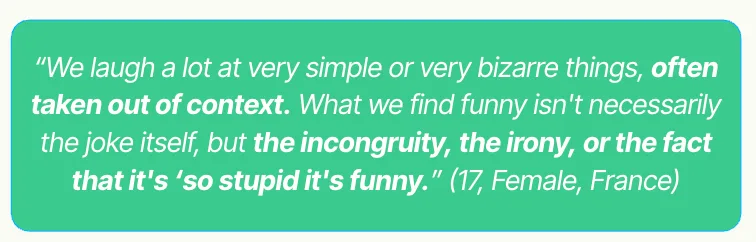
Third, irony is infrastructure. Humor increasingly lives in the space between sincerity and detachment, with 91% believing things can be funny and serious simultaneously 1. A joke does not need a clear punchline, and audiences often find themselves simultaneously making fun of something while genuinely caring about it.
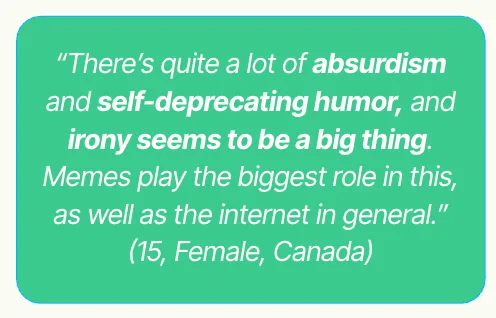
Finally, jokes must grow. Humor today thrives on escalation, remixing, and evolution – with 88% saying humor gets funnier the more it builds or continues 1.
Every Joke Has a Social Lifecycle
Understanding how humor works is only half the challenge. The bigger question for brands is knowing when – and how – to join the conversation.
The research shows that brands are never neutral participants. When a brand joins a trend, it changes it:
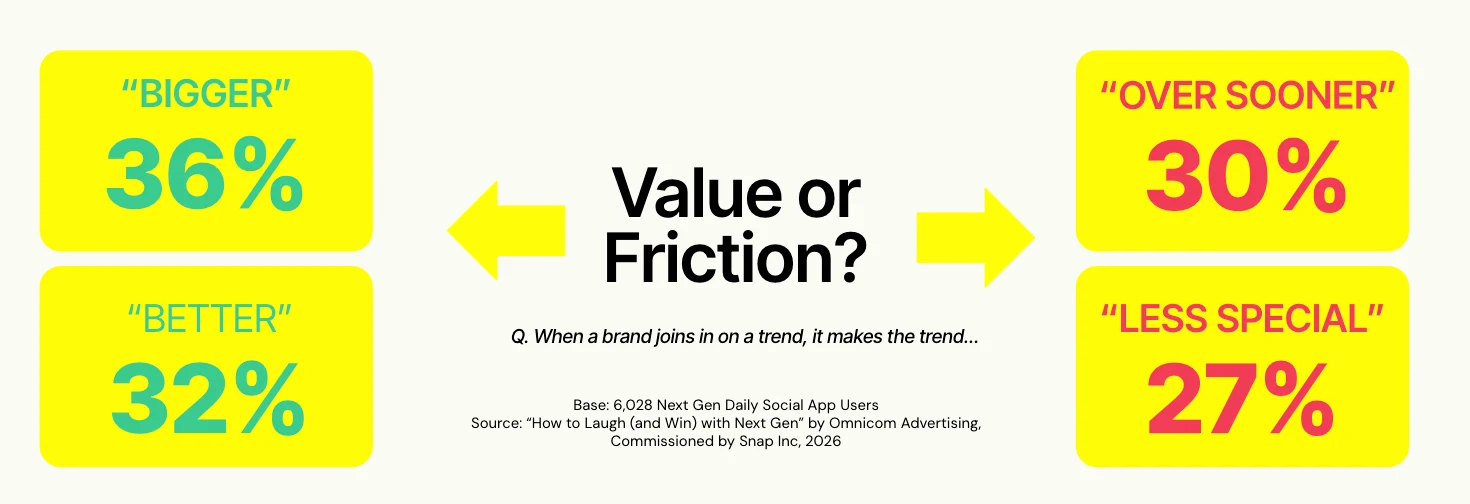
In other words, every brand interaction could either make or break a joke.
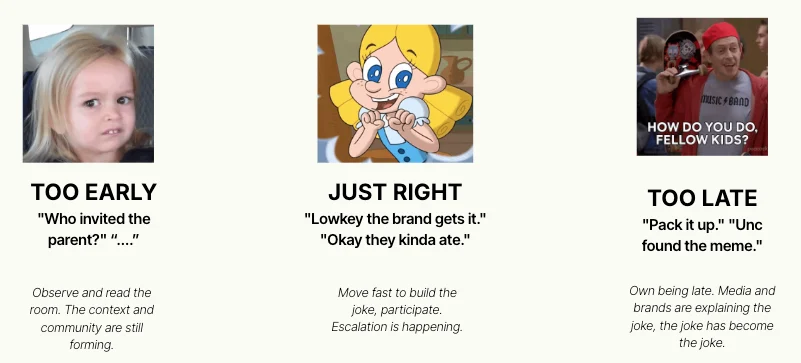
Timing is equally important as 91% agree the same joke can feel funny in one place and awkward in another 1. Internet humor moves incredibly quickly as brands that arrive too early risk misunderstanding the joke, and those that arrive too late risk becoming the joke. The greatest opportunity lies in what we call the “Goldilocks Moment” – when communities are still actively building, remixing, and evolving the idea:
There are three distinct stages brands should recognize:
Too Early: The community is still creating the language and context around the joke. Brands should observe rather than participate, taking time to understand the references and how the humor is evolving.
Just Right - The “Goldilocks Moment”: The joke is spreading, people are remixing it, and the community is still adding new layers. This is the moment for brands to contribute something original that helps the joke grow rather than simply borrowing it.
Too Late: The joke has already been explained by mainstream media, copied by multiple brands, or become overly familiar. At this stage, participation often signals that a brand is out of touch rather than culturally fluent.
Snapchat: Where Humor Becomes Social
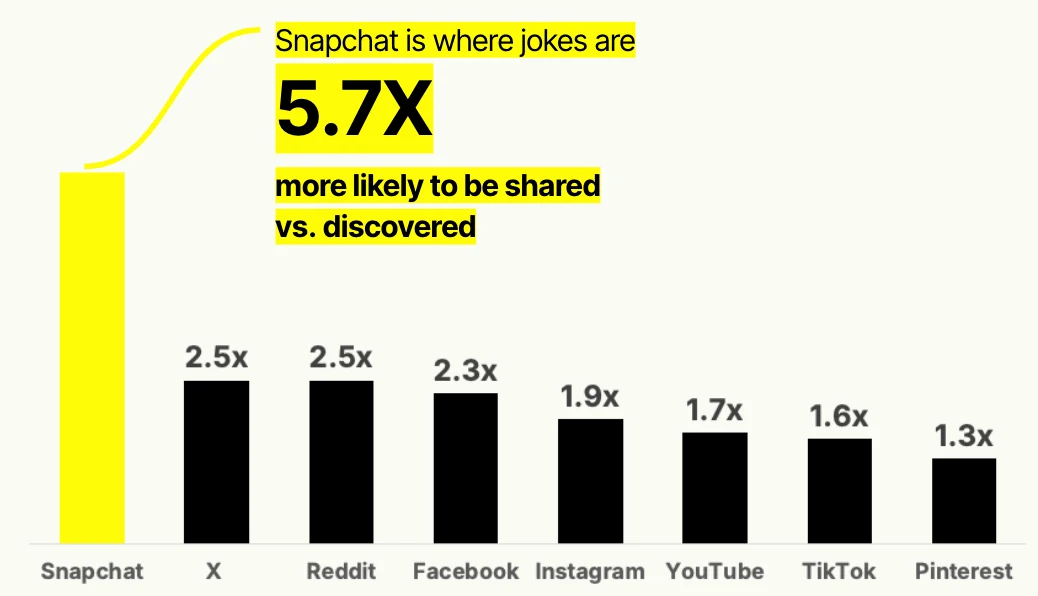
Snapchat plays a distinctive role in helping jokes become personal. Across all platforms measured, Snapchat demonstrated the strongest movement from discovery to sharing. It is the place where jokes are nearly 6X times more likely to be shared than discovered 1. Humor becomes more valuable as it moves between close friends and family on Snapchat.
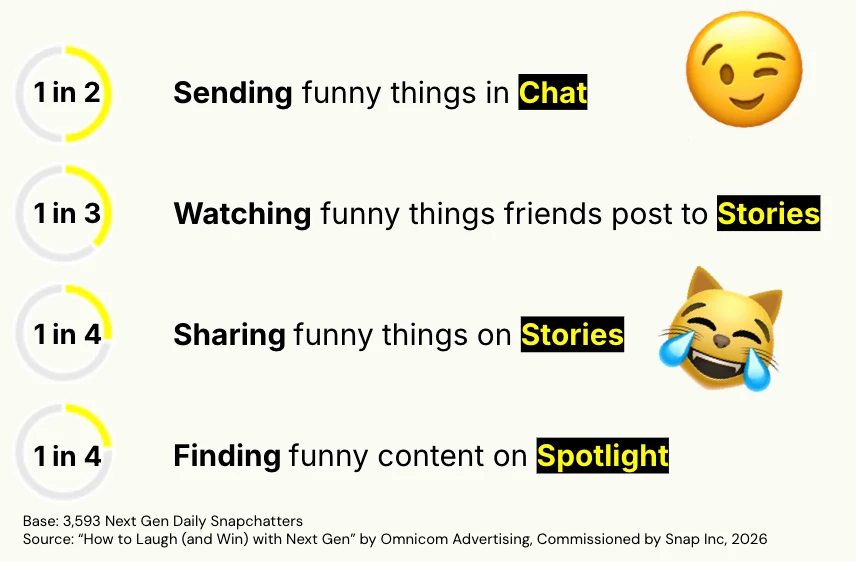
Among daily Snapchatters, humor also extends across the platform. Rather than functioning as one destination, Chat, Stories, Spotlight, creator content, and AR Lenses each support different parts of the joke’s journey.
Snapchat is also uniquely associated with participatory humor. It is the #1 platform associated with Filters, Effects, and Lenses; one in two Snapchatters create their own funny content using AR tools; and 82% say they enjoy brands collaborating with their favorite funny creators 1. Together, these findings position Snapchat as a platform where audiences actively shape humor rather than simply consume it.
What This Means for Brands
Humor has become one of the most powerful ways younger audiences build relationships, communicate identity, and participate in culture. Brands have permission to join that conversation, but only when they understand how it works.
While internet humor can seem chaotic or impossible to decode from the outside, we found it actually follows a surprisingly consistent set of mechanics. By understanding those mechanics, brands have a stronger foundation for creating humor that feels authentic, culturally relevant, and genuinely worth sharing.
The brands that succeed won't necessarily be the funniest. They'll be the ones that first learn the language, build ideas around the mechanics of modern humor, contribute at the right moment, and create formats people genuinely want to share, remix, and build upon.
For Snapchat specifically, the opportunity extends beyond simply creating humorous content. The platform enables brands to transform humor into social connection through creator collaboration, participatory AR experiences, private sharing, and community-driven creativity. Rather than optimizing only for views or impressions, brands have the chance to create ideas that people actively want to send, build on, and make their own.
Ultimately, the opportunity is no longer simply to tell the joke – but to help Next Gen make it their own.
Download the full report hereMore Ways To Win With Snapchat


Snapchat can help your business grow.